
“A molecule can be dried hard, heated and shipped. A living tumour-killer cannot — it has to arrive alive, at a known count, after drying, storage and reconstitution, and freeze-drying is where most of the population dies. That is not a detail standing between this result and a medicine. It is the thing standing between them, and it is the exact problem we build instruments for. We did not find this organism. We are building the only way it ever reaches a patient.”
Bogdan Dicoias — biochemist and inventor · Director of Panacea Bio Chem Ltd
ONCOLONIZE™ — the platform, and why this comes from Panacea Bio Chem
ONCOLONIZE™ is the Panacea Bio Chem platform for living medicines that have to arrive alive. Its premise is that bacterial oncology has had its hard problem solved in the wrong order: the biology works — a coloniser that concentrates in a tumour and kills from inside it has now been shown to clear every tumour in a treated group — while the part that turns that result into a medicine has had almost nothing built for it.
A conventional drug is a molecule, and a molecule survives being manufactured. A live biotherapeutic is a population, and every step between the flask and the patient is a chance to kill it. Ice crystals during freezing. Osmotic shock on rehydration. The terminal heat a conventional lyophilisation cycle uses to finish. Oxygen, for an organism that concentrates in hypoxic tumour cores. A programme that ignores this produces a paper. It does not produce a dose.
Ewingella americana is ONCOLONIZE™’s lead candidate: the organism whose 2025 result makes the question urgent, and the one this platform is being taken through first. No Panacea result on E. americana is claimed anywhere on this site, and the experiment described here is somebody else’s. The claim being made is a different one, and it is ours: the instruments that make a living tumour-killer survive becoming a product exist here, and substantially nowhere else.
| Rung | Technology | What it settles |
|---|---|---|
| Dry it without killing it | Lyochrysalis™ · LyoLevit™ | Our lyophilisation machine, and the zero-contact orbital sublimation inside it — the cake levitates and spins rather than sitting on a shelf, heat arrives as 360° radiation instead of floor conduction, and the terminal overheat a conventional cycle finishes with is not part of the process. For a molecule that is a quality argument. For a population it is the difference between a dose and a sterile powder. |
| Keep oxygen off it | OxyDeplete™ · ArgonLock™ | Degassing plus a no-headspace design, finished under argon, so there is no oxygen reservoir left to re-equilibrate. An organism that concentrates in the hypoxic core of a tumour should not spend two years in air. |
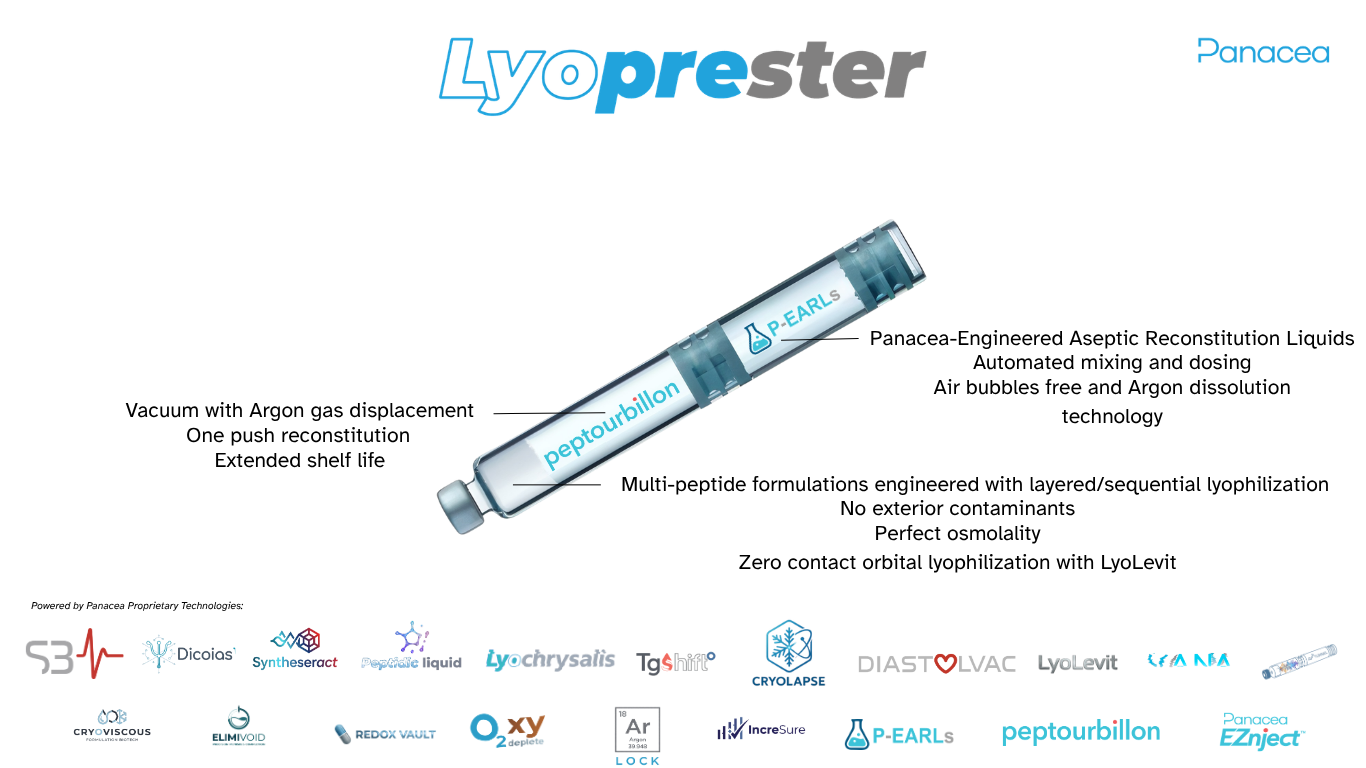
| Hold it | Lyoprester™ · P-EARL™ | The two-chamber pre-filled syringe: the dried cake under vacuum and argon in one chamber, its tuned P-EARL reconstitution liquid in the other. The plunger draws liquid into cake in situ. No open vial, no mixing step, and no argument afterwards about how many viable cells were actually administered. |
| Know it | Dicoias Ψ™ · Peptourbillon™ | The mathematics. Dicoias Ψ reduces every substance and every excipient to a vector on the same six axes of protective demand, scores the recipe as a shortfall energy and prescribes what to add — before anything is weighed. Peptourbillon turns that into masses, ratios and volumes. |
| Run it | S3Pulse™ | The control system: it runs Lyochrysalis, holds the process doctrine and keeps the run record, so a batch has a derivation and not merely a result. |
The first goal is a strain that survives drying alive. The next is a living medicine that arrives at the tumour at a known, provable count. The ultimate goal is a cancer cured by an organism that goes where a drug cannot — dosed from a cartridge, by a person who never has to wonder whether it was still alive when it got there.
1. What Ewingella americana actually is
Before the story, the organism — because almost every popular account of the 2025 result skips straight past it.
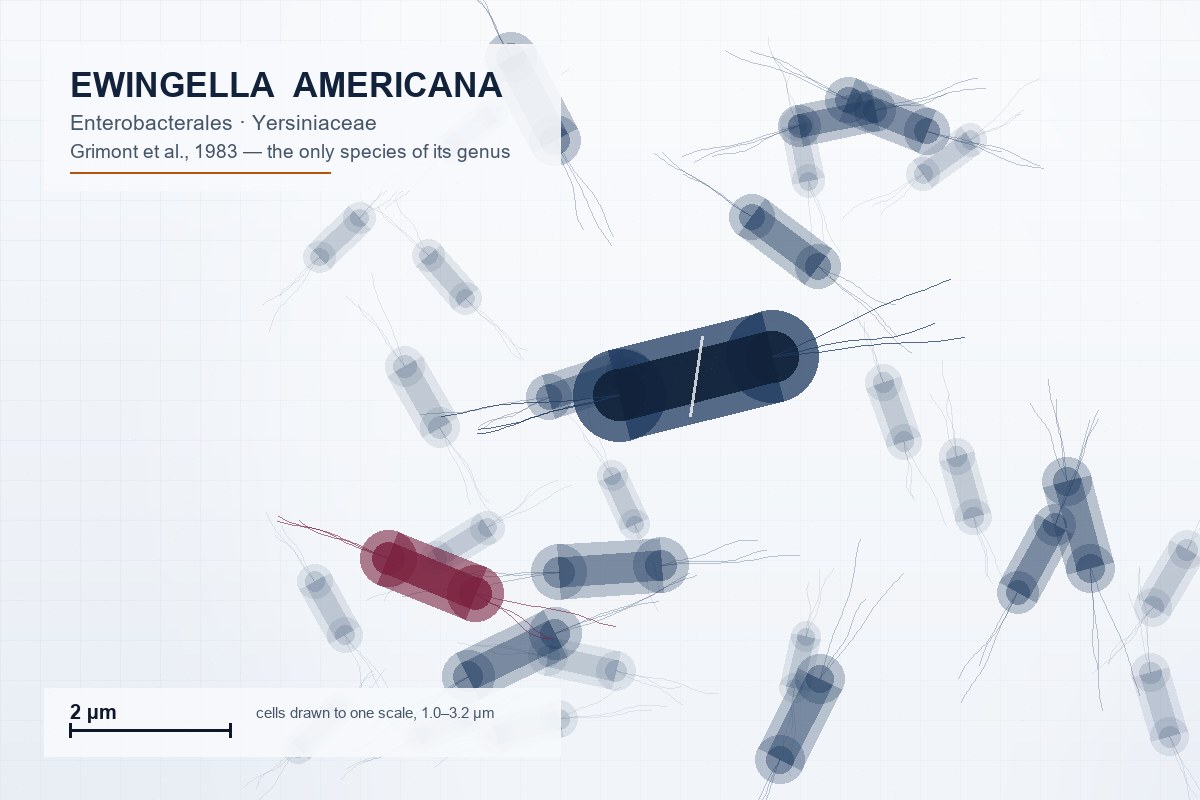
- Order Enterobacterales
- Family Yersiniaceae
- Genus Ewingella — monotypic
- Described 1983, Grimont et al.
- Gram negative rod
- Respiration facultative anaerobe
- Catalase positive
- Oxidase negative
- Reference genome 4.67 Mb, 4,301 genes, 53.8% GC
The genus carries one species and no others, which is unusual enough to be worth saying plainly: whatever is true of Ewingella is true of Ewingella americana. The name honours William H. Ewing, whose work at the United States Communicable Disease Center gave the Enterobacteriaceae much of the order they still have.
It is a generalist. It has been recovered from soil, fresh and marine water, molluscs, insects, cultivated mushrooms, plant roots, retail food, an Antarctic environment, and from human blood, sputum, urine, stool, synovial fluid, conjunctiva and peritoneal dialysate. A comparative genomic study of the genus led from Shenyang Agricultural University and Jilin Agricultural University sequenced the reference strain B6-1 from the needle mushroom Flammulina filiformis and found something telling: the origin of a strain did not significantly affect its position in the phylogeny, while mobile genetic elements did most of the shaping (Liu Z et al., Pathogens 2020, PMID 32354059). The strains from mushrooms and the strains from people are not two separate organisms wearing one name.
That single finding is what makes everything below coherent. A species this promiscuous, carrying a common toolkit of secretion systems, effectors, carbohydrate-active enzymes and toxins across every host it was pulled from, is exactly the sort of organism that can turn up as a mushroom disease in Iran, a blood-culture ghost in an American hospital, an enzyme source in Antarctica, and a tumour-seeking agent in a Japanese mouse — without any of those being a mistake.
2. Forty-two years as a footnote
The literature on this organism is small enough to read in an afternoon. Sixty-one records are indexed in PubMed for its name. That is the entire published history of a species.
The first fame was not even an infection. In the mid-1980s, hospitals began finding Ewingella americana growing in blood cultures from patients who were not septic. McNeil and colleagues traced it to a persistent environmental reservoir and to cross-contamination inside non-sterile blood-collection tubes (Journal of Clinical Microbiology 1987, PMID 3571454; and PMID 4019740 on the contamination mechanism itself). The organism’s debut in medicine was as a pseudobacteraemia — a phantom, an artefact of the laboratory bench.
Real infections followed, slowly and sparsely: bacteraemia in an intensive care unit (1986), conjunctivitis (1991), septicaemia (1992), peritonitis in patients on ambulatory peritoneal dialysis (1999, 2014, 2020, 2022), pneumonia in chronic renal failure (2005), a fatal Waterhouse–Friderichsen syndrome (2003), the first meningitis in a term newborn (2020), and a urinary tract infection recorded as a first in 2023. The pattern is consistent and it matters: these are people who are immunocompromised, catheterised, dialysed or newborn.
In 2024, Ioannou, Baliou and Kofteridis at the University of Crete did the sensible thing and counted. Searching PubMed and Scopus, they found 16 studies describing 19 patients — the complete published human record of this species. Median age 55. Bloodstream, respiratory and peritoneal infections most common. Resistance to cephalosporins, aminoglycosides and trimethoprim–sulfamethoxazole minimal. Overall mortality: one patient (Antibiotics 2024, PMID 38927225). Case-report evidence
Meanwhile the organism was doing far more economic damage somewhere else entirely. It was first isolated from the cultivated button mushroom Agaricus bisporus in 1996 (Inglis PW, Current Microbiology, PMID 8875916), and it causes internal stipe necrosis — a browning that destroys the mushroom from the inside of the stem outward, invisible until the crop is cut. It has been documented in Korea (PMID 23983509), in retail mushrooms in Zaragoza (PMID 19712317), and across 38 farms in 15 provinces of Iran between 2018 and 2021, where 40 separate strains were recovered and the authors called it an emerging threat to the national industry (Hamidizade M et al., Phytopathology 2023, PMID 36131391). Field evidence
3. December 2025: the frogs, the newts and the lizard
The question the Japanese team asked was not “what can Ewingella do?” It was much stranger than that, and the strangeness is the reason the result exists at all.
Shinya Iwata, Eijiro Miyako and colleagues at the Japan Advanced Institute of Science and Technology in Nomi, Ishikawa, started from a premise nobody had systematically tested: that the gut microbiomes of lower vertebrates — amphibians and reptiles — are an unexplored reservoir of bacteria with therapeutic properties. They collected from three ordinary Japanese animals: the tree frog Dryophytes japonicus, the fire-belly newt Cynops pyrrhogaster, and the grass lizard Takydromus tachydromoides.
Forty-five distinct strains came out of those guts. Nine survived biocompatibility screening and went forward. Six of the nine were Ewingella americana, all from the tree frog. When the nine were tested for antitumour activity, one of them was not like the others.
The headline numbers, taken from the paper rather than from the press coverage of it: Animal evidence
| What was measured | Result |
|---|---|
| Dose and route | a single intravenous tail-vein dose, 200 µL of 5 × 10⁹ CFU/mL |
| Complete response at day 30 | 100% of treated animals |
| Anti-PD-L1 comparator, same study | one complete response |
| Liposomal doxorubicin comparator | no consistent tumour eradication |
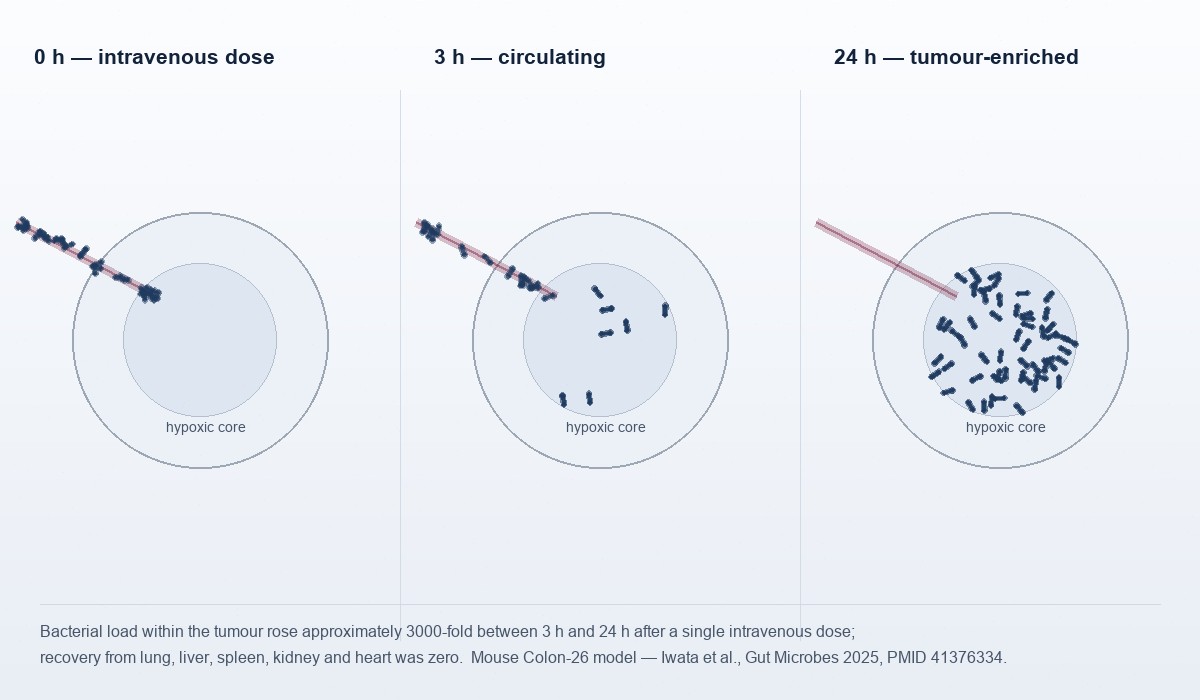
| Tumour enrichment | approximately 3000-fold between 3 h and 24 h after dosing |
| Recovery from lung, liver, spleen, kidney, heart | zero |
| Blood clearance | undetectable by 24 h |
| Tumour rechallenge in cured animals | 0 of 10 grew tumours, against 10 of 10 naïve controls |
| Immune shift within the tumour | CXCR4+ neutrophils +30%, CD3+ T cells +5%, CD19+ B cells +3%; IFN-γ and TNF-α elevated |
| Direct killing | secreted cytolysins; tumour spheroids largely destroyed within 24 h at 5 × 10⁸ CFU |
| Organ histology and blood chemistry | no significant difference from saline controls |
The rechallenge line is the one that should make an immunologist sit up. Mice cured by the bacterium and then given fresh tumour cells did not grow tumours — while every naïve control did. Whatever happened, it did not end when the bacteria were cleared from the blood at 24 hours. Something was left behind that remembered.
The full experiment, panel by panel, with what it did not show →
4. What the experiment did not show
The authors are careful about this, and their carefulness is worth more than any amount of enthusiasm.
One tumour, one model
A subcutaneous Colon-26 model in BALB/c mice. The authors name the limitation themselves: this differs from an orthotopic colorectal model, and future studies in other cancer types are needed before anything like broad-spectrum activity can be claimed.
No human evidence at all
Not a trial, not a compassionate-use case, not a single treated person. As of September 2026 there is no registered clinical study of Ewingella americana as a therapeutic. Human interventional evidence: none
Species is not strain
The active organism was a wild isolate from an amphibian gut. The type strain ATCC 33852 was used only for computational virulence-factor analysis. “Ewingella americana is antitumour” is therefore a species-level shorthand for a strain-level finding.
Hypoxia is not the whole answer
The paper states plainly that the total absence of colonisation in other hypoxic tissue shows hypoxia is necessary but insufficient. Something else about tumour tissue is doing part of the selecting, and nobody yet knows what.
The dose question is also open and the authors raise it: the therapeutic dose is a substantial live bacterial load delivered intravenously, and they flag dose fractionation as a consideration for any translation. A therapy that works by putting a living organism into the bloodstream has a margin to establish, not merely an efficacy to prove.
5. The contradiction nobody should hide
June 2025. A cancer patient receiving chemotherapy in Istanbul develops sepsis during a red-cell transfusion. Blood cultures grow Ewingella americana. The patient is treated with ceftriaxone and recovers fully. It is reported as the first such case in Türkiye (Jafarova Ayik H et al., Cureus 2025;17(6):e85641, PMID 40636648). Case-report evidence
December 2025. The same species, from a frog, eliminates tumours in 100% of treated mice and is reported to show minimal pathogenicity at therapeutically effective doses. Animal evidence
Both of those are true. Neither cancels the other, and any page that presents one without the other is misleading by omission. What separates them is not luck — it is four things, and naming them is the whole of the honest answer:
| Variable | The Istanbul sepsis | The JAIST experiment |
|---|---|---|
| Strain | an environmental or nosocomial isolate, unselected | a specific wild isolate from an amphibian gut, selected out of 45 for biocompatibility |
| Host | a human with chemotherapy-suppressed immunity | immunocompetent mice |
| Route and intent | accidental, during transfusion | deliberate, dosed, single intravenous administration |
| Outcome | sepsis, resolved on ceftriaxone | tumour elimination, no organ colonisation, cleared from blood by 24 h |
The Iranian mushroom survey found the same principle in a completely different kingdom: pathogenic and non-pathogenic strains of this species sitting in neighbouring branches of one clade. This organism’s behaviour is not a property of its name. It is a property of the strain, the dose, the route and the host — and the fact that it remains treatable with an ordinary cephalosporin is, if anything, an argument in favour of studying it rather than against.
6. Why a bacterium can go where a drug cannot
The interior of a solid tumour is the worst-served real estate in the body — and the best possible address for an anaerobe.
A tumour outgrows its own blood supply. The result is a core that is hypoxic, acidic, poorly perfused and locally immune-suppressed. Every one of those properties is a problem for a conventional drug: a molecule that arrives by the bloodstream reaches the well-perfused rim and thins out toward the middle, which is precisely where the most treatment-resistant cells sit.
For a facultative anaerobe, the same description reads as an opportunity. It can grow with oxygen or without it, so the oxygen gradient that stops a drug is no barrier; the local immune suppression that protects the tumour also protects anything living inside it; and a bacterium, unlike a molecule, replicates once it arrives. That is the difference between a dose that decays from the moment it is given and a dose that grows. The measured 3000-fold enrichment between three and twenty-four hours is not distribution — it is division.
The killing then runs on two tracks at once, which is what the authors mean by a dual mechanism. Secreted cytolysins — haemolysin and exotoxin activity — lyse tumour cells directly; in three-dimensional spheroid culture the highest bacterial concentration largely destroyed the spheroid within twenty-four hours. In-vitro evidence Simultaneously, a large bacterial presence inside a previously immune-quiet tumour is an unmissable alarm: neutrophils rose by 30%, T cells and B cells followed, and interferon-γ and TNF-α rose in the tumour tissue. The organism does not have to finish the job. It has to make the tumour visible.
How this compares with Coley’s toxins, Salmonella VNP20009 and Clostridium novyi-NT →
7. The other lives of this organism
A species that turns up in an Antarctic sample and a Japanese frog in the same decade is telling you something about itself.
Antarctica, and a sweetener
In January 2026, a group at the Universidad de Santiago de Chile, with the Universidad de Talca and Universidad Mayor, reported an Antarctic isolate designated L47, identified as Ewingella americana. Genome mining found an unusual combination in one bacterium: a single L-arabinose isomerase gene alongside three β-galactosidase genes. That pair of activities is exactly the two-step route from dairy lactose to D-tagatose, a low-calorie sweetener. The recombinant isomerase proved manganese-dependent and reached about 18% tagatose from 100 mM galactose in 48 hours under the conditions tested, with the isomerase — not the galactosidases — identified as the bottleneck (Rivero K et al., International Journal of Molecular Sciences 2026;27(2):1128, PMID 41596769). Genomic and biochemical evidence
The mushroom farms
The agricultural lane is the largest body of work on this organism and almost none of it reaches the popular coverage. Beyond internal stipe necrosis, a 2025 study examined the volatile organic compounds the bacterium produces and their toxicity to Pleurotus pulmonarius (Wei Z et al., Toxins 2025, PMID 41003513) — an organism that can damage its host at a distance, through the air, without contact.
Insects, plants and fish
It has been found as a growth-promoting bacterium in the guts of insects feeding on tomato plants (PMID 36362334), among root-associated bacteria of the Brazil pine (PMID 21596540), among bacteria that inhibit the sporogonic development of Plasmodium falciparum in Anopheles mosquitoes (PMID 8375488), and in molluscs (PMID 7580799). The through-line is a competent, adaptable coloniser rather than a specialist of anything.
8. Panacea Bio Chem’s angle: the hardest part of a living medicine is keeping it alive
Ewingella americana exposes a formulation problem directly relevant to Panacea’s technology domain: if a viable biological therapeutic is ever to be presented in a dried/reconstitutable format, preservation of biological function through processing, storage and reconstitution becomes central. No Panacea result on E. americana itself is claimed.
Panacea Bio Chem does not make this organism and claims no result on it. The reason this subject sits inside Panacea’s research attention is a different one, and it is the problem that stands between every result like the one above and an actual medicine.
A conventional drug is a molecule. It can be dried hard, heated, shipped, stored for years and dissolved when wanted. A live bacterial therapeutic is not a molecule — it is a population that has to arrive alive, at a known count, after drying, storage, distribution and reconstitution. Every step of that chain is a chance to kill the product. Freeze-drying is where most of them die: ice crystal formation, osmotic shock during rehydration, and the terminal heat that conventional lyophilisation uses to finish a cycle.
That chain is the whole of Panacea’s engineering. Lyoprester™ is a proprietary Panacea Bio Chem dual-chamber cartridge platform developed and invented by Bogdan Dicoias; its parameters and composition are not publicly disclosed. It matters here for a structural reason rather than a marketing one: in a Lyoprester cartridge the diluent is already present, in its own chamber, and reconstitution is an actuation rather than a manual procedure — no vial, no separate diluent, no syringe drawn up and injected down a glass wall, no operator technique in the loop. The bypass wets the dried cake from the base upward. For a fragile biological cake, the difference between a controlled wetting front and a jet of diluent is the difference between a product and a loss.
The instruments that address each place a living product dies
Lyoprester™ — reconstitution stops being a procedure
The only dual-chamber cartridge that is autoreconstitution-enabled, vacuum-sealed and argon-fillback — which is the part that matters for something alive. Oxygen is what degrades a dried biological preparation in storage, slowly and invisibly, long after the cycle that made it has been signed off. A cartridge that holds its cake under inert gas for the whole shelf life is not a packaging refinement; for a living product it is a condition of the thing still being alive when it arrives.
LyoLevit™ — the cake never touches anything
The cake levitates and spins in high orbit, driven by ultrasound and RF. A cake lying on a shelf dries unevenly by definition: the contact face and the free face are two different thermal environments, and what survives in one is not what survives in the other. Take the shelf away and the population dries as one population. For a molecule that is a quality improvement. For something alive it is the difference between a count you can state and a count you can only hope for.
Cryolapse™ — no crust, because a crust is a lie about dryness
Cryogenic pressure collapse under S3Pulse™ control, with vapour redistributed through the whole cake rather than across its surface, impeding crust formation. A crust tells you the outside is dry and says nothing whatever about the middle — and the middle is exactly where the residual moisture that quietly kills a stored population sits.
P-EARLs™ — waking is a step, and steps can kill
Panacea-Engineered Aseptic Reconstitution Liquid(s), each tuned to the thing it wakes. Rehydration is not the end of the process; it is the last opportunity the process has to destroy what the whole cycle was spent protecting. Closure is held by SealoPrester™, the Aseptic Cartridge Closure System — and for a live product, closure sterility is not a quality metric, it is the product.
Lyoprester™, LyoLevit™, Cryolapse™, P-EARLs™ and SealoPrester™ are proprietary Panacea Bio Chem platforms and processes developed and invented by Bogdan Dicoias. Their parameters and compositions are not publicly disclosed.
Put the chain together and the position is plain rather than boastful: the drying, the containers and the reconstitution engineering that any live biotherapeutic would eventually need already exist, and Panacea Bio Chem builds them — which is why the world’s most demanding peptides are made and preserved here rather than anywhere else. The chain runs from synthesis, through the Peptourbillon™ formulation range, into the Lyoprester dual-chamber cartridge, and out the other side intact. Judge it on the chain rather than on the claim.
9. What would actually settle it
The questions below are the honest state of this subject in September 2026. None of them has an answer yet.
- Does the effect survive a move to an orthotopic or spontaneous tumour model?
- Does it hold in any tumour type other than Colon-26?
- Which secreted factor does the direct killing, at molecular resolution?
- Is the rechallenge immunity antigen-specific to the tumour, or general activation?
- What is the therapeutic index in an animal with a compromised immune system?
- Can the result be replicated by an independent laboratory?
The last of those is the one that matters most, and it is the one the field has been burned on before. The tumour-microbiome literature carries a prominent retraction: the 2020 Nature paper by Poore and colleagues proposing a microbial-signature cancer diagnostic (PMID 32214244) was retracted in 2024 (retraction note, PMID 38926587). That does not touch the Ewingella work, which is a wet-lab experiment rather than a sequence-mining analysis — but it is the reason this page reports what was measured in a mouse and declines to extrapolate past it.
10. Frequently asked questions about Ewingella americana
- What is Ewingella americana?
- A Gram-negative, rod-shaped, facultatively anaerobic bacterium of the order Enterobacterales and family Yersiniaceae — the only species in its genus. Described in 1983 by Grimont and colleagues from ten clinical strains in the United States, and named after the CDC bacteriologist William H. Ewing. Catalase-positive, oxidase-negative. Recovered from soil, water, mushrooms, molluscs, insects, an Antarctic environment and human clinical specimens.
- Does Ewingella americana kill cancer?
- In mice, in one published experiment, it eliminated tumours completely. Iwata and colleagues reported in Gut Microbes in December 2025 (PMID 41376334) that a single intravenous dose of a strain from a Japanese tree frog gave a 100% complete response at day 30 in a Colon-26 mouse model, outperforming an anti-PD-L1 antibody and liposomal doxorubicin tested alongside it. That is animal evidence from one tumour model in one laboratory. There is no human evidence and no registered trial.
- Can I get this as a treatment?
- No. There is no approved therapy, no registered clinical trial and no interventional human evidence for Ewingella americana in cancer as of September 2026. The work is preclinical, in mice.
- Is Ewingella americana dangerous?
- It is an uncommon opportunistic pathogen rather than a virulent one. The complete published human record, assembled in 2024, is 16 studies describing 19 patients, median age 55, with one death overall and minimal antibiotic resistance (PMID 38927225). Serious infection has been reported chiefly in people who are immunocompromised, catheterised, dialysed or newborn.
- Why is it in my mushrooms?
- Because it is a real mushroom pathogen. It causes internal stipe necrosis in Agaricus bisporus and soft rot in Pleurotus, documented in Korea, Spain, China and Iran — where a 2018–2021 survey of 38 farms across 15 provinces recovered 40 strains and called it an emerging threat to the industry (PMID 36131391).
- How does a bacterium find a tumour?
- A facultative anaerobe survives in the oxygen-poor, immune-suppressed tumour interior that circulating drugs penetrate worst — and then divides there. In the 2025 work, tumour bacterial load rose roughly 3000-fold between 3 and 24 hours after one intravenous dose, with zero recovery from lung, liver, spleen, kidney or heart and clear blood cultures by 24 hours. The authors state that hypoxia is necessary but not sufficient to explain it.
- Is this just Coley’s toxins again?
- Same lineage of idea, different instrument. Coley injected bacterial preparations into sarcoma patients from the 1890s (PMID 16789469); the modern line runs through attenuated Salmonella VNP20009 and spore-forming Clostridium novyi-NT. What is unusual here is that the organism was neither attenuated nor genetically modified — it was taken from a frog’s gut and used as found.
- What else is it good for?
- An Antarctic isolate, L47, carries one L-arabinose isomerase and three β-galactosidases — an uncommon combination in a single bacterium — of interest for converting dairy lactose into the sweetener D-tagatose. The recombinant isomerase reached about 18% tagatose from 100 mM galactose in 48 hours under the conditions tested (PMID 41596769).
11. Trending in the field
Recent developments in the field — refreshed 2026-11-02 by Panacea Bio Chem.
- Discovery and Preliminary Characterization of Lactose-Transforming Enzymes in Ewingella americana L47: A Genomic, Biochemical, and In Silico Approach — PubMed, 2026 Jan 22
- Discovery and characterization of antitumor gut microbiota from amphibians and reptiles: Ewingella americana as a novel therapeutic agent with dual cytotoxic and immunomodulatory properties — PubMed, 2025 Dec 31
- Toxicity of Volatile Organic Compounds Produced by Pathogens Ewingella americana and Cedecea neteri Associated with Pleurotus pulmonarius — PubMed, 2025 Sep 5
- Sepsis Caused by Ewingella americana in an Immunocompromised Patient: A Case Report — PubMed, 2025 Jun
11. Glossary
Terms used on this site, in the sense this site uses them.
| Term | What it means here |
|---|---|
| Bacterial oncolysis | Tumour destruction in which a living bacterium, not a molecule, is the agent. The bacterium colonises the tumour and kills from inside it. |
| Tumour colonisation | Selective multiplication of a bacterium inside tumour tissue rather than in healthy tissue — the property that makes the approach possible at all. |
| Obligate / facultative anaerobe | An organism that requires, or merely tolerates, the absence of oxygen. Solid tumours carry hypoxic cores, which is why anaerobes concentrate there. |
| Abscopal / rechallenge immunity | Protection against a later tumour that was never treated, implying the immune system was taught rather than the tumour merely poisoned. |
| Orthotopic model | A tumour grown in the organ it arises from, rather than under the skin. Harder, and closer to the disease. |
| Colony-forming unit (CFU) | One viable, dividing cell. The dose unit of a live biotherapeutic — and the thing that drying destroys. |
| Live biotherapeutic product | A medicine whose active ingredient is a living organism, which must therefore arrive alive, at a known count, after manufacture, drying, storage and reconstitution. |
| Lyophilisation | Freeze-drying. Where most of a live product's population dies: ice-crystal damage, osmotic shock on rehydration, and the terminal heat a conventional cycle uses to finish. |
12. References
Every identifier below was resolved live against the NCBI E-utilities API on 19 September 2026. Identifiers are given in the text as well as here, so that a citation survives being quoted out of its markup.
- Iwata S, Yamasita N, Asukabe K, Sakari M, Miyako E. Discovery and characterization of antitumor gut microbiota from amphibians and reptiles: Ewingella americana as a novel therapeutic agent with dual cytotoxic and immunomodulatory properties. Gut Microbes 2025;17(1):2599562. PMID 41376334. PMC12710904. PubMed record
- Ioannou P, Baliou S, Kofteridis D. Ewingella americana infections in humans — a narrative review. Antibiotics (Basel) 2024;13(6):559. PMID 38927225. PMC11201141. PubMed record
- Jafarova Ayik H, Eyupler C, Yassa G, Aksu C, Duman N. Sepsis caused by Ewingella americana in an immunocompromised patient: a case report. Cureus 2025;17(6):e85641. PMID 40636648. PMC12240595. PubMed record
- Liu Z, Sheng H, Okorley BA, Li Y, Sossah FL. Comparative genomic analysis provides insights into the phylogeny, resistome, virulome, and host adaptation in the genus Ewingella. Pathogens 2020;9(5):330. PMID 32354059. PMC7281767. PubMed record
- Hamidizade M, Taghavi SM, Moallem M, et al. Ewingella americana: an emerging multifaceted pathogen of edible mushrooms. Phytopathology 2023;113(2):150–159. PMID 36131391. PubMed record
- Rivero K, Valenzuela R, Rivero I, et al. Discovery and preliminary characterization of lactose-transforming enzymes in Ewingella americana L47. International Journal of Molecular Sciences 2026;27(2):1128. PMID 41596769. PMC12842569. PubMed record
- Grimont PAD, Farmer JJ 3rd, Grimont F, et al. Ewingella americana gen. nov., sp. nov., a new Enterobacteriaceae isolated from clinical specimens. Annales de Microbiologie (Institut Pasteur) 1983. PMID 6847036. PubMed record
- McNeil MM, Davis BJ, Anderson RL, et al. Ewingella americana: recurrent pseudobacteremia from a persistent environmental reservoir. Journal of Clinical Microbiology 1987. PMID 3571454. PubMed record
- Wei Z, et al. Toxicity of volatile organic compounds produced by the pathogens Ewingella americana and Cedecea neteri associated with Pleurotus pulmonarius. Toxins (Basel) 2025. PMID 41003513. PubMed record
- McCarthy EF. The toxins of William B. Coley and the treatment of bone and soft-tissue sarcomas. Iowa Orthopaedic Journal 2006;26:154–158. PMID 16789469. PubMed record
- Nejman D, Livyatan I, Fuks G, et al. The human tumor microbiome is composed of tumor type-specific intracellular bacteria. Science 2020;368(6494):973–980. PMID 32467386. PubMed record
- Poore GD, Kopylova E, Zhu Q, et al. Microbiome analyses of blood and tissues suggest cancer diagnostic approach. Nature 2020;579:567–574. PMID 32214244. RETRACTED — retraction note Nature 2024, PMID 38926587. Retraction note
13. About this page
Concept and direction: Bogdan Dicoias, biochemist and inventor.
Published by: Panacea Bio Chem Scientific Communications.
Last evidence search: 19 September 2026 — NCBI E-utilities, complete indexed PubMed corpus for Ewingella americana (61 records), plus native-language searches of Chinese and Russian scientific databases.
Evidence classes used on this page and kept separate everywhere a claim appears: AnimalIn vitroCase reportGenomicFieldHuman interventional — none exists
On the international search: the Chinese contribution to this organism is substantial but published in English by Chinese institutions — Shenyang Agricultural University and Jilin Agricultural University own the comparative-genomics and mushroom-microbiome work cited above. Chinese-language databases (CNKI, Wanfang, CQVIP) return edible-mushroom bacterial-disease literature but no antitumour work on this species. Russian-language databases (CyberLeninka, eLIBRARY) carry general literature on bacterial and microbiota-based tumour therapy but returned nothing naming Ewingella. Those are absences recorded after searching, not assumptions.